
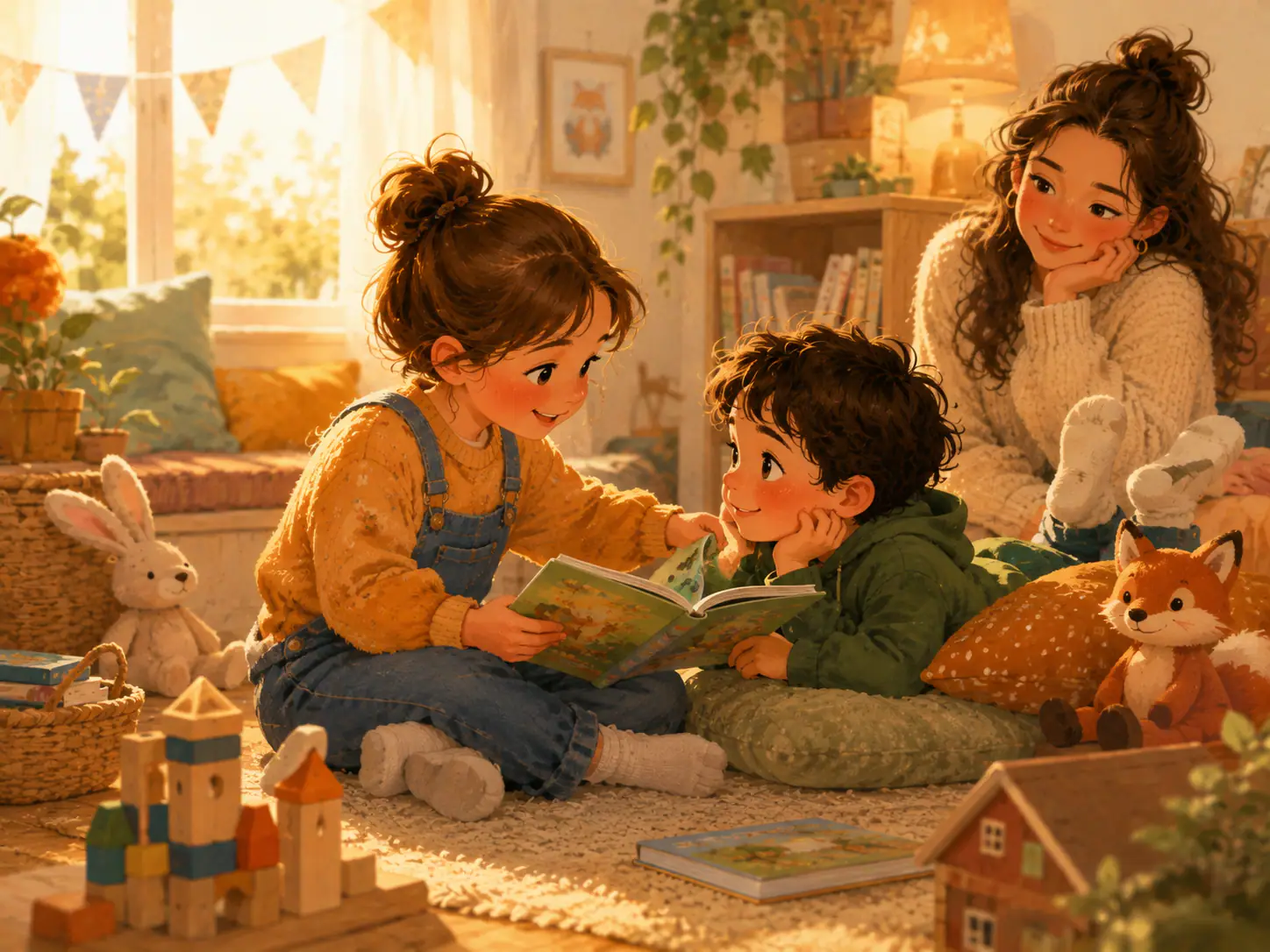
Knowing what comes next can feel good
Adults often look for novelty, while young children may enjoy the opposite: a story whose path is already familiar. Knowing that the frightening moment will pass, the joke is coming, or the character will find the way home can make a book feel safe enough to explore more deeply.
Familiar words become easier to own
On a first reading, a child is following the plot. On later readings, there is more attention available for repeated phrases, unusual words, sentence patterns and sounds. Children may begin to finish a line, repeat a favourite expression or retell part of the story in their own words. That participation is one reason repetition can be so satisfying.
The pictures change even when the book does not
A detailed illustration can reveal something different each time: a character in the background, an object that appears before it matters, a change in colour, or an expression that was missed while listening to the words. Re-reading turns a picture book from a sequence of pages into a place the child knows well enough to investigate.
Repetition can make big feelings easier to approach
If a story contains worry, sadness, embarrassment or suspense, familiarity can reduce uncertainty. The child already knows the difficult part and also knows what follows it. That can create room to talk about the character’s feelings without the pressure of discovering the plot at the same time.
You do not have to read it exactly the same way
A repeated book can become a new conversation. One night, read the whole story. Another time, pause over the pictures, let the child tell the story, look only for one character, or ask what changed between two pages. The book remains familiar while the shared-reading experience keeps changing.
When should you offer something new?
There is no need to retire a favourite simply because it has been read many times. Keep other books available and invite variety without turning it into a battle. Familiar books and new books do different jobs: one offers mastery and comfort; the other brings surprise. A healthy reading shelf has room for both.